Tuesday, 7 May 2013

The First Siege at Fort Meigs

From May 1 to May 9, 1813, the timber fort, Fort Meigs, at what is now Perrysburg, Ohio, was under siege by a force of British regulars, Canadian militia, and First Nations warriors. This "first siege" consisted of bombardment of the forts by  6, 12, and 24 pound field pieces, a 5.5 inch howitzer, and 5.5 inch and 8.5 inch mortars as well as infantry attacks by the 2,200 men under General Proctor. Garrisoning the fort were US regular infantry and artillery and militia units from Virginia, Pennsylvania, Kentucky, and Ohio. The siege was lifted when General Proctor received word that York, Ontario (Now Toronto) had fallen and US troops might be moving up behind him. As "second siege" followed in July (July 20-28), but this appears to be less effective, because of the lack of heavy artillery for the Crown forces.

This past weekend saw the 200th Anniversary of this first siege with a large reenactment at the fort. The original fort was abandoned in 1815, so the fort as it stands today is a rebuild. The only thing left of the original is the so-called "grand traverse," a long mound erected to protect the defenders from bouncing cannon balls. The Old Northwest Military History Association was host to over 600 reenactors from the USA and Canada. The ONMHA "garrisons" the fort with reenactors who serve as both infantry and artillery.

An aerial view of the modern reproduction of the Fort. This appears to be a photo
taken during the modern reconstruction. The blockhouses and palisade are incomplete
and the traverses are missing.
My family and I set up camp as a cook's tent and we were joined by the Herb's and Haves'. On the field, we were folded into the other group the reenacts the 17th US, who are from Erie, PA. The 17th was one of the Regular Army regiments at the fort during the siege.
The combined 17th... I'm on the far left, Robby has his back to the camera in a soft cap.

The Ontario contingent of the 17th...
Jonathan, John, Josh, Robby, Andrew, Matthew, and Lyle.

Robby and I in our uniforms... sewn by Beth!
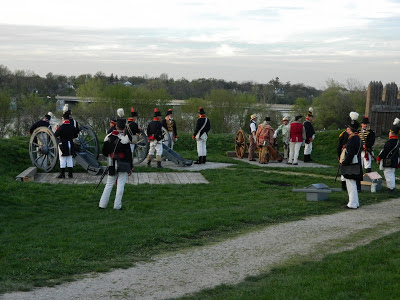
Friday evening saw a cannonade from the fort and from the "British" batteries across the Maumee River.
The Fort Meigs gunners and US Volunteer gunners make ready.

The crews at one of large batteries.
Saturday, the fort was open to the public and the place was hopping. We had a reenactment of the battle that led to Dudley's Massacre, in which a number of captured Kentucky militiamen were made to run the gauntlet and were killed. (We didn't reenact the gauntlet; no fun there.)
Shoulder arms!

US Rifles on the left, US Volunteers on the right, "Brigade Music" in the middle.

Preparing to leave the parade ground for the battle.
Since my wife and daughter were our photographers and were left to tend the fire, I don't have many photos of the Saturday engagement. The Regulars came to the rescue of the Kentucky Militia, and we withdrew after a spirited exchange. We left the fort over one of the battery walls and struggled down a steeper hillside that had been covered by abittis until a few years ago. Then we marched ("Route march! Break step!") up a dry, rocky creek bed to face a lot of dead Kentuckians and regular light infantry as the First Nations warriors "looted" and "scalped" them. I pealed off to walk back on my own rather than face the creek bed and hillside again. (Yes, I am lame in more ways than one.)
From another source... the US Regulars advance.

From another source... We  prepare to fire. We're already loaded.
Saturday evening, there was period dance. I attempted but failed at the Virginia Reel as both of my knees and my back protested. The fort also supplied a little free beer for the reenactors.
Beth and I prepare to leave camp for the dance. Our medals are 1812
Bicentennial medals given to reenactors, only to be worn on period clothes.

Katie, in the green hunting frock, dances with a Royal Artilleryman.
It got rather chilly that evening!

Fiddlesix, a local period music group, kept things lively.

Carrie, Robby, Mark, and Bryce converse at the dance.
Sunday saw more visitors and another reenactment. This time the US troops left by a gate... like gentlemen! Since I started reenacting in Ontario, I'm used to seeing at least twice the number of redcoats when compared to the American blue. This event was the opposite.
The 19th US Infantry advances as light infantry. Robby is in the far file in  his flat cap.

Caldwell's Rangers, a Crown unit, skulking. This unit tended
to fight alongside the First Nations warriors.

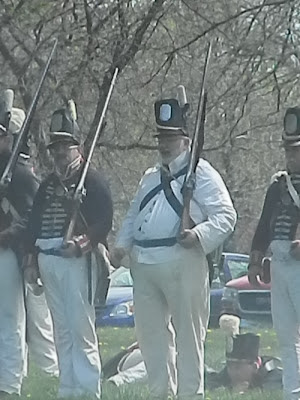
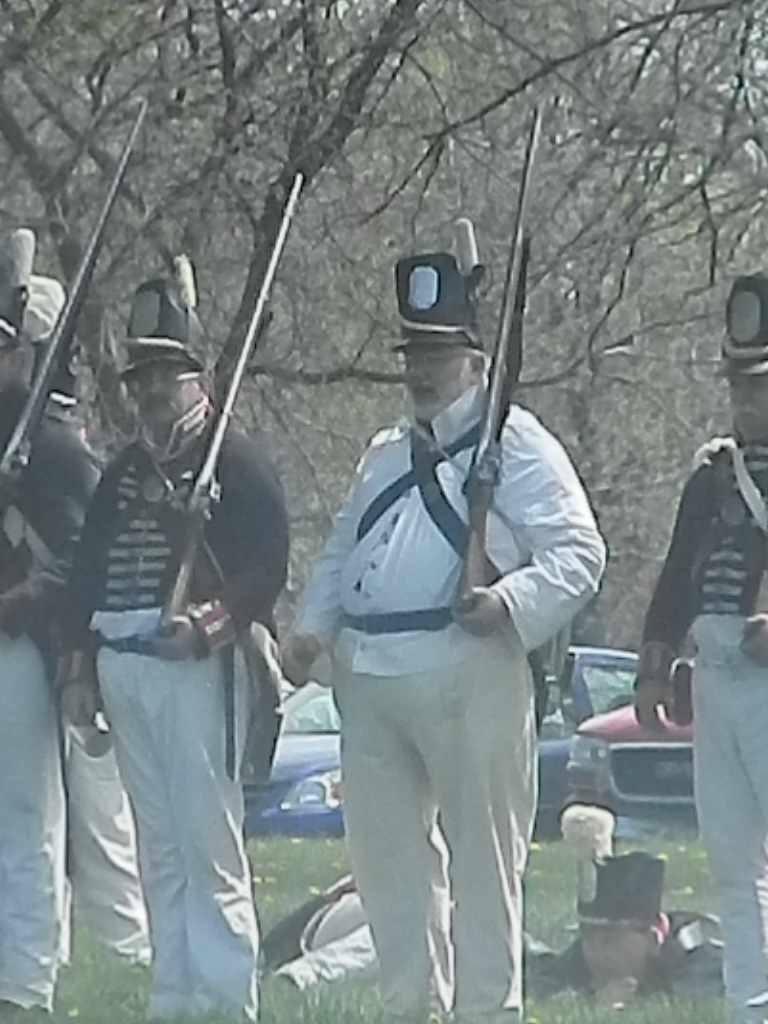
The 19th and the 1st Rifles keep up a hot fire.

US Light Artillery, an elite unit. I was truly impressed.

State of New York Militia

Our Mohawk friend, Many Strings, loading while prone. That's not easy.

"Load in quickest time!" I wore my white cotton roundabout on Sunday
as it was warmer than Saturday with less wind.
Many Strings prepares to take the battle to the enemy
with his (silicon rubber) tomahawk.

Awaiting the order to advance.

"The front rank will kneel!"
I had to switch place with my friend Lyle since some arthritis keeps me from such things.

This chieftain was pretty impressive.

Lyle had  "fallen" so I moved up to the front rank.
A fallen First Nations warrior hold a handful of grass to his "wound."

I'm slow but I'm in the line. Lyle is prone behind me, grassing his wound.

Caps off to honour the memory of all the fallen.

Tami, one of the hosting group, provided commentary at the battle.
She usually turns out as a sergeant of artillery, but a broken foot
kept her out of the battle..
All in all, it was a good event. I was told this was larger than average for the Fort Meigs events, which is not surprising considering it was the Bicentennial of the siege. The whole thing was well handled and I'll continue to compliment the organisers, especially Tami, Marty, "Lieutenant Dan", and Gus, who had his university exams the next day. My thanks to Ed - the 17th sergeant, Olly - who captains the 22nd and took on our youngest as his runners, Betsy - who graciously took Robby into her light infantry unit, and Colonel "Fightin' Rob" who orders the whole thing.
A few extraneous photos:
The only thing worse than packing might be re-packing.

Katie in her period gear.

The Boy gobbles macaroni and cheese made in the style of Thomas Jefferson,
who brought the dish over from France. Made with milk, cheese, and flat noodles
in a Dutch Oven, IT WAS DELICIOUS!  I WANT TO HAVE IT AGAIN SOON!

Katie embroiders in camp while Robby loiters on one of the traverses.
He spent a lot of time on that rise and left his shape in the soil.

I have taken "the King's Pineapple" and I'm being inducted into the Royal
Hawaiian Immigrants. ("King Kamehameha's Own") There are no rules, no
command structure (and appearently no standards), but I have to make a period
workshirt out of the most vile Hawaiian shirt material I can find.
I'm honoured. I'm humbled. I'm sick to my stomach.

Matthew and Josh served as runners for the 22nd US Infantry.
According to their report, they died gloriously!
Our next big reenacting gig should be Stoney Creek in July although there is an 1812 education day and small event this weekend and a World War I education day in Mississagua in a few weeks. Summer will be busy.

Sunday, 14 April 2013

Renaissance Renewed

In former years, Renaissance gaming (aka 'Pike & Shot') was one of my favourite periods to game. I don't know what happened... Well, I do but I'd rather not pick that scab right now. In any event, when Martin broached the subject of playing Pike & Shot again, I was eager to play. This all came up in discussion of DBA and DBR rules. As I said in a previous blog, I was opposed to playing DBA for a number of reasons, but once I discovered the "big battle" system, and played it twice, I was hooked. Martin and I had been discussing a Thirty Years War game using DBR (De Bellis Renationis by Wargames Research Group) and on Saturday it came to be.
We decide on 500 points each. Martin chose a German Catholic army and I took the Swedes of Gustavus Adolphus. My army included Cuirassiers, "light cavalry" (not so light really - both Swedish and German), "inferior German cavalry", and Finnish Hakapelli. The cuirassiers and light cavalry charge at the trot and fire pistols just before contact, the inferior cavalry fire by ranks en Caracole (fire and retire by ranks) and try to use fire power rather than the sword in the attack, and contact is made at the walk. The Hakapelli attack at the full gallop... and they are nuts. My infantry was Pikes (one superior, one ordinary), shot, and a Warband of raw Irish/Scots with hand weapons only. Added in were two battalion guns, two ordinary field guns, and one superior field gun. Martin's troops were much the same - superior pistol-armed cavalry, some ordinary pistol-armed cavalry, pike and shot regiments, and six guns, including two siege guns. (Heavy, merciless SOB's)
Martin's left flank division - pike'n'shot, dragoons, commanded shot, and pistol armed cavalry.

My centre - Swedish pike'n'shot, a battalion gun, and the general.
The die shows how many "pips" the division has. Any sort of manoeuvre costs pips.

New German Cavalry fighting for Sweden with some commanded shot.
Rob commanded this wing which included Swedish and Hessian Cuirassiers
and German mercenary cavalry as well.


Martin's centre division, commanded by Derrick.
We all agreed that London Hydro wanted their poles back from the pikemen.
Derrick commanded the German infantry centre and Rob led the Swedish left flank division, mostly cavalry. We diced for aggression and the Swedes became the attacker. We diced for weather - FOG! Just what every Swedish player wants to see! Shades of Lützen! Anyway, Rob and I gamely advanced and the fog blew away in the second turn. Both of our flanks, cavalry heavy, advanced quickly and the centre, anchored in more ways than one by the slow artillery, followed. The Germans (whom I had been originally told were going to be French) held firm, but their left came out to meet my Swedish and Finnish cavalry.
It didn't go well for us Lutheran types. Our command dice were very low. Through no fault of his own, Rob actually rolled three ones in one turn - triple snake-eyes!  Simpson snake-eyes!  (aka "a Homer")  My Finns tried to turn the flank of the German left but there were only two stands of Hakapelli and it wasn't enough. The Dragoons met them and shot at them from the woods, killing one stand. Martin later said the dragoons were the proverbial "tar-baby" to mess up my advance. (If you don't know your Uncle Remus references, a tar baby is a distraction that fixes a person's attention and action on a worthless struggle. You end up being tied up and unable to back away, since it's made of tar.)

Two views of the dragoons 'dry gulching' my Finns.
On the Swedish left, Rob was quite aggressive and moved his cavalry quickly. They came to grips with Martin's superior cavalry and some pike'n'shot. In the meantime, Derrick gleefully bombarded my infantry and right flank cavalry with 4 heavy guns. I detached my Gaels to support the right, but they stalled due to lack of command pips. Both Rob and I rolled horribly for command pips and that got frustrating.
Martin adjust his left flank division and dragoons.
He borrowed the commanded shot from me, hence the
Blue Bonnets on the end.


Two views of Derrick's infantry/artillery line. By the end of the game,
he'd picked off 4 out of 5 of my cannon.

That gap in my formation USED to be a battalion gun.
Rob and Martin fought a very confusing cavalry-heavy melee on the Swedish left. Meanwhile the Swedish right's morale was shattered and they began to fall back. In the end, by Swedish infantry in the centre never reached the German infantry formations. We had started too far away and there was too much ground to cover while being fired upon and while moving at artillery speeds. (We didn't check how wide the table was to be in the rules, so we'd been advancing from a line about six inches from the table edge.)
My Swedish "light cavalry" hit Martin's pikes and general.
We were cut up.

Rob's German Cavalry (Right) followed by his Curassiers meet
Martin's superior cavalry.

Cavalry engaged. Commanded shot firing at the French shot.
The New German Cavalry fires their pistols at a distance.

The melee continues and the bases thin out.

The Swedish and Swedish-employed Germans hack and slash
at the German-employed Germans.

From Martin's side, the New German cavalry attack the pikes
with pistol and sword.
In the end, we had to concede the battle. We just didn't have the stuff. I still find DBR clunky but I did enjoy the game and I'll play it again. One good sign (a second was Martin's pledge to cut his pikes down to a more realistic size.  "Can you get UHF on those things?" "Bucko, you can get Tierra del Fuego!"), he want to look over the old WRG Renaissance rules by George Gush. These are the rules I first played back when the Earth was young and I've still got them. It may be a while but we'll try them. Until then, I can deal with the odd things in DBR since I'll get to play Pike & Shot period
The raw Gaels advance futilely to support the Swedish cavalry.

My Swedish Light Horse begins to fragment.

Derrick - in his Evil Empire shirt - prepares to bombard me...
again.
.Lessons ---
  • Don't ever throw all ones for your command roles in DBR... never, never, never.
  • Make sure your table is the right size. Very little is more frustrating than parading over a too-large field under heavy artillery fire.
  • Don't separate small units from the main body. It cost one 'pip' to move all the stands in a division if they are touching. It costs two "pips" to move a unit that not in base-to-base contact.
Next week: more Naval Thunder for World War I... or so I'm told.

Sunday, 7 April 2013

Fall Gelb in Kriegspeil mit Einweg Heldern

"Case Yellow (the invasion of France) in wargaming with Disposable Heroes" for them what don't speak/read/understand German. (as if I really did.)
The place: The Hamilton Road Gaming Group at the Crouch Branch Library
The time: April 6, 2013 or sometime in 1940 if you prefer.
The players: Stu, Stephen, John, Derrick, Tyler, Rob, and Martin
The Kibbitzim: Andy (who designed the scenario) and Kevin

I, for one, wanted to play this so I could see Martin's DH French army and the vehicles (a Char B, Renault-35 and -40, a Somua, an AMR-35 ZT, a 'Matilda', and a handful of Bren carriers.) That was fun!
The Somua - I can't help it... I REALLY like the look of these early war French AFVs!

Char B - not too active in the game, but when it did, it acted decisively!

Renault -40   brewed up early, thanks to the Stukas.
Don't you love the "Shoot here!" rondels?

Renault-36  ditto the above
{Martin, I may have the proper designations confused. My apologies!
I just take delight in how good they look!}

AMR-35 ZT  "Tinfoil armour with a machine gun."
The German forces (two infantry platoon with the usual mortar/HMG/Pak cannon attachments, a motorised infantry platoon with mortar/HMG/Recon, 2 PzIV medium tanks, 2 Pz 38t light tanks, 2 SdKfz 251s hauling LMG teams) advanced up a road toward a bridge over an impassable-to-vehicles river/stream being held by a mixed French-British force.  Lots of activations ~ maybe too many. Oh, yes, and three Junkers Ju-87 Stukas which did incredible damage at the beginning of the game, knocking out the Matilda, the Somua, and both Renaults.
the Allied side of the table, with French troops lurking in the ruins.

One Stuka ---- Scratch one Matilda

Second Stuka ---- Scratch two Renaults

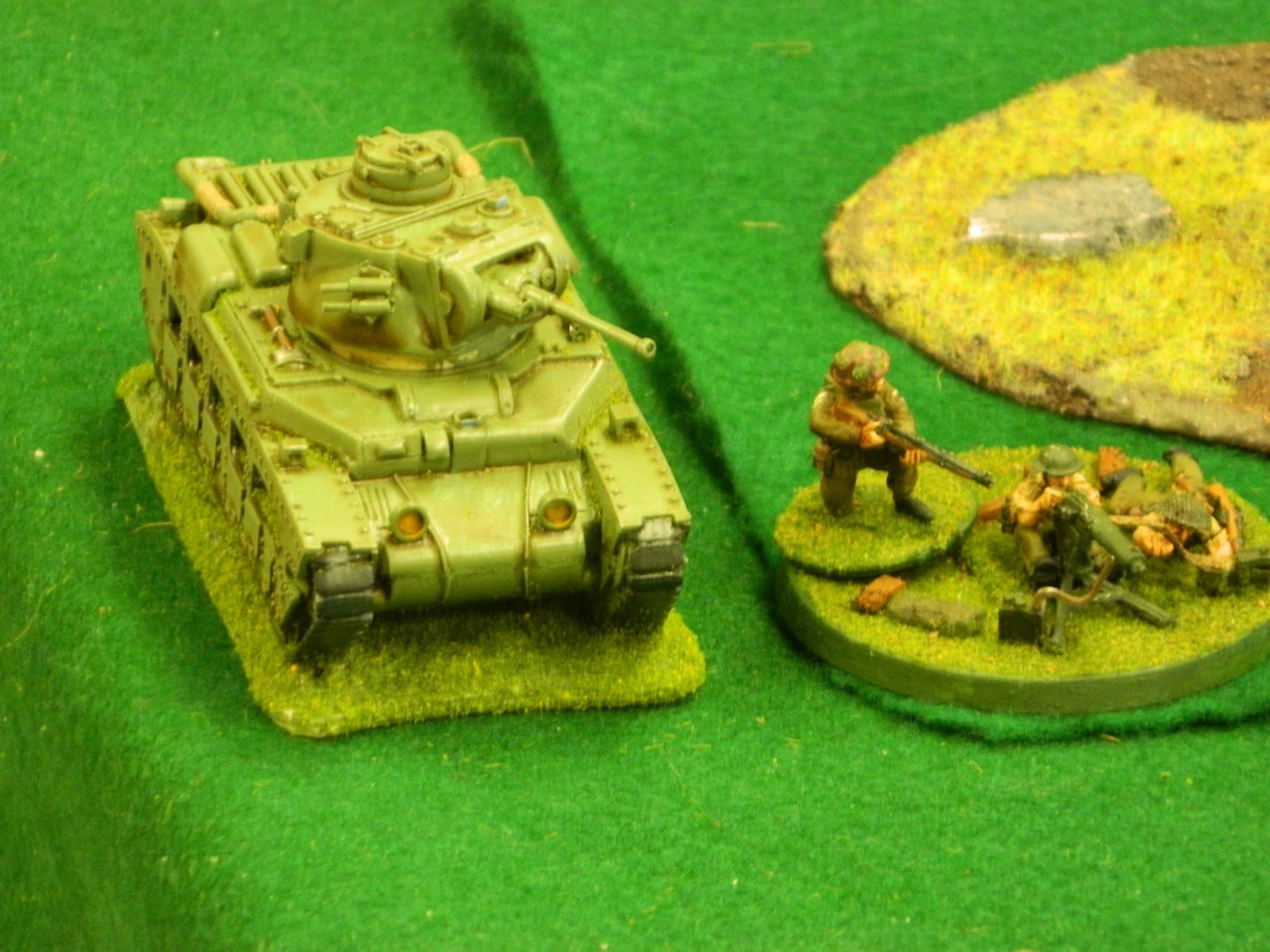
The Matilda and some Tommies with a Vickers gun in better days.
The German troops advanced all along the front, with tanks leading the charge up the road. It wasn't really a "charge" but a rather deliberate advance at moderate speed. Machine guns on both sides caused a lot of casualties. The German Pak gun and one mortar crew were taken out quite quickly.
The HMG section was badly hurt. The green bingo chip means the unit is "activated" while
the red chip means it failed it's morale and cannot advance. 2 chips - fall back; 3 chips - rout!
The paper/cardboard figure now are being used to show casualties. We used to either leave the figures
which clutters the board or put down blue bingo chips... which is too abstract for my tastes.
A visit to the "Junior General" website (paper soldiers and models) gave me some casualty markers.
We're really not that blood-thirsty; it just helps us to see where the casualties were taken.

The Wehrmacht advance. Andy said later that the hedges were supposed to be
HEDGEROWS, which would've made a big difference in both casualties and movement.
Stu got one 38t and a PzIV over the bridge at one point. Then it got really interesting. (By this time, Andy was suffering from a bad back and had been just watching the game. Kevin arrived late and opted to moderate and provide colour commentary. I dropped out of the game for various reasons and took photos. Derrick took over my command.) By interesting, I mean "close assault by infantry on armour". Rob attacked the 38t with a squad of Brits and Martin swarmed the PzIV with a larger squad of French. Nobody had EVER seen this before... except for me! It was a Soviet vs. German game 5 years ago at a local hobby shop. Stephen was looking through the DH  rule book in a fever when I said I'd run the assault judication. ("Oh, thank God!" he said.) It ended up that Rob's Brits failed to truly assault the 38t and were machine gunned. The French hit the PzIV and immobilised it! (In DH, the first attack is called an 'improvised assault' and the most damage it can do it immobilise the tank. Immobilised means no more movement. The second assault is the time for firing through view slits and grenading the engine covers and hatches. That's when the tank can be destroyed.) As it was, the PzIV was immobilised on the bridge and lost 3 of five crew. The second assault failed but the tank was stuck on the bridge. The 38t was stuck on the other side of the bridge. The second 38t was on the edge of the woods at the stream and the main gun of the Char B took it out. The PzIV on the bridge was later knocked out by Tyler with a mortar round. (Once a year, Tyler hits paydirt and does something really wild in a game. This time he knocked out a tank with a mortar round through the top armour. Last year, he knocked out a Hetzer with a US bazooka - just barely, but knocked out is knocked out.)
The 38t takes cover behind the immobilised PzIV. The survivors of the British
assault are in the middle of the road.

The memorable assault! The Brits have failed morale and the French are busily
assaulting the bigger tank.

Ah! The sniper in the bell tower! How cliche!

A photo of the German advance from earlier in the game.

The French Hotchkiss HMG. It earned it's pay in this game.
It fires very slow, slower than the Russian Maxim.

More French infantry, preparing to assault the tank.

A Boys Anti-tank rifle hiding in the rubble.
The game ended soon after because of curfew. (The library closes at 5 and we all like to be out by then.) The Allies DID hold the German advance to their side of the stream and they could probably have staged an orderly withdrawal. The German infantry could've crossed the stream but none elected to. They sort of hopped from cover to cover. Mortars on both sides dropped smoke a lot, except for Tyler's lucky/skillful shot on the tank. (You decide which description to use.) The Germans had a lot of infantry squads almost untouched and if we had been more aggressive earlier, the game might have turned differently. (I say "we" because at the beginning of the game, I was running the motorised infantry.) The use of Stukas at the beginning of the game was a surprise and one that the Allies did not at all like.

Lessons:
  • I've got to learn to be more aggressive. I'll ask my wife - a veteran Renaissance player - to teach me. Since I play Napoleonic Austrians a lot, aggression come hard for me in some instances.
  • Push your tanks; they can move fast.
  • When you play, make sure you have not been up since 5:30am that day. Being tired really takes the edge off and makes the eyes blur.
  • Note to self: When you play, define your terms! Make sure everyone knows what the terrain represents. Maybe label it somehow?
  • I'm beginning to think that our games might be getting too big. If I recall correctly, the Germans had to go through 30 or more activations every turn. Since there were 3 players, we did them 3 at a time, but it still got tedious.
  • Now that the ice is broken, expect more aircraft in the game. Rob has 2 P-51s on his painting board. Yeah. I've got a Typhoon in a storage box somewhere, too. I might be time to find a Sturmovik as well.
Maybe a few more photos. After all, that's why you come to the blog, right?
The French '75' lurking in the churchyard. It didn't do much since it attracted fire.

French mortar - Tyler's tank killer!

Rob's British infantry

A suitably suave French officer. I don't know if he survived.
His smoking would've killed him eventually. 

German HMG team and a recon squad --- camo helmet covers gave them away.
Bren Carrier by Martin, painted for his Sikhs
British infantry painted by me.

Traffic jam at the bridge and infantry advancing slowly through the woods.

The unlucky German anti-tank gun, anti-tank rifles and other infantry.
Next week -baring anything unforseen, Martin and I intend to bring out the Pike and Shot troops! I like that period as well. We've both been secretly working on armies in our hidden lairs.
10mm ECW/TYW cavalry. We'll be using 15mm armies.