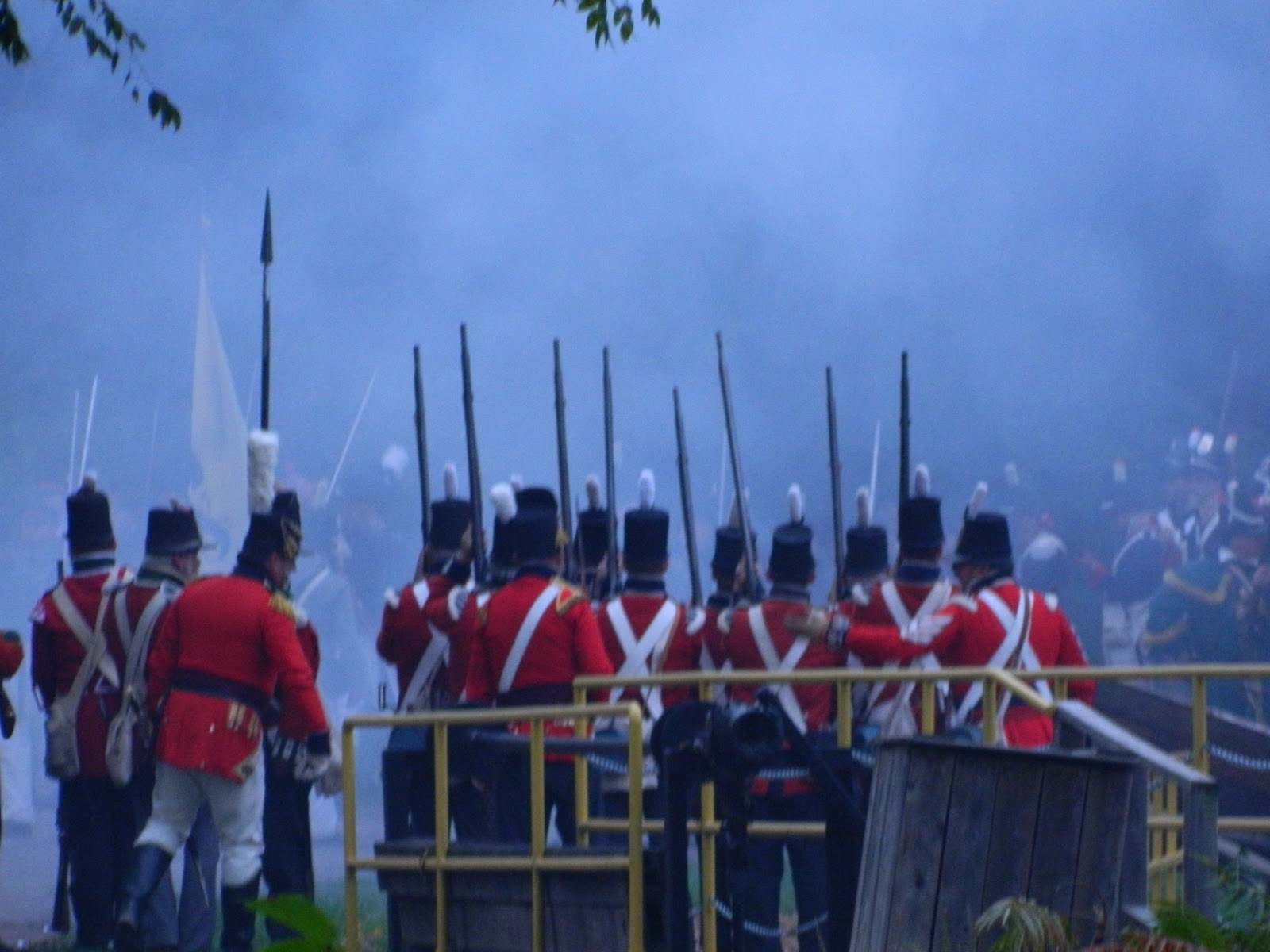
Monday, 24 September 2012

War of All Against All

Date:       22 September, 2012
Place:      Crouch Library, Hamilton Road, London, ON
Rules:      Disposable Heroes / Coffin for Seven Brothers
               (World War II small unit skirmish)
Sides:      Free-for-all!
Players:   Andy, Martin, Rob, and myself

Andy came up with a scenario of each player preparing a roughly 1000pt. army list of infantry, infantry support weapons, and one AFV. Each player would set up and fight ALL THE OTHER PLAYERS, no matter what nation. The objective was to be the last man standing. Oy vey! So Martin took his Sikhs with a Chuchill, a 6# AT gun with Bren to tow it, AND a 17# AT gun with a Bren as prime mover. Robby took British paras with a Cromwell. Andy had Russians, a KV-1 and a 76mm AT gun. I took my SS reinforced platoon (HQ section with a Panzerschreck attached, 3 2-section squads, an MG-42 HMG team, and an 8cm mortar team) with a Tiger I.


The initial set-up -- Andy called the scenario "Berlingrad" and he is seen taking photos of the set-up. I'm sitting by my deployment area. Andy is standing by Martin's deployment space. Andy set up in the corner, left foreground and Rob was set up in the right foreground. The objective: "Get 'em!"
 
Andy's Soviets. I think he had three mortars, maybe four. Of course, I demanded he use the flag! The playing card was a way to randomise deployment. Cards were set on the table and cards from a second deck were drawn by the players. You set up where your card matched. Originally we were set for 6 players, but two of the fellows couldn't make it at the last minute.
 
My SS abteilung - the Tiger I is out of the photo on the far right. You can just see the fender. At the far left, carrying their own wheat sheaves, is my sniper team... who actually survived the game! That's a knocked out Pz. 38t in the woods beyond the grain field. It made a good place to hide an LMG team.
 
Martin's Sikhs - he paints the turbans of each squad in a different colour, which makes sense game-wise and really detracts nothing from the look of those very business-like troops. 2-inch and 3-inch mortar teams skulk in the rear of his deployment.
 
Rob's Paras with their Cromwell. The troops reached the church as curfew fell. The Cromwell used it's speed to pop in and out of cover, keeping it out of the Tiger's sights... for which referred to my son as a "sneaky weasel." He continues in the great tradition of the games at the Ritz BBQ in Allentown, PA - one player shall always be the "Mentula Mustellae." (Latin - in polite English, "the genitals of the weasel." Impolitely, "weasel d**k") 
 The initiative changed every full turn and I was almost always last. ("Such is life.") Andy cautiously rounded the corner to face my Tiger with his KV-1 while his infantry made a dash for the houses on the street that separated our forces. I also ran for the housed and got into one on his side of the road. I held it for a while but was wiped out a short while later.
One of my squads when left to face the Sikhs, who hammered the squad's LMG team. Martin slowly worked his way around my left flank, through the woods. His 6-pounder and my sniper and LMG team exchanged fire for most of the game.
Rob dashed toward Martin to take some of the Socialist Realism Housing Development (cinder block semi-cubes) to face off Martin. They were heading toward each other but were separated for most of the game. Andy and I were closest due to the luck of the cards.


The centre of the table - I have a section in the big building, the HQ section and another rifle section are poised to make a run for the houses to the left of the big building. The Tiger is gingerly advancing. The Kubelwagen the the halftrack in the photo are usable, the pz. 38t and the Pzkwgn. IV are knocked out and serve as terrain. You can also see Soviet infantry advancing toward the housed in the bottom of the photo.

Not much later - the KV-1 and the 76mm AT gun are advancing. Andy's line of mortars is setting up to throw smoke to help Rob, who had made a temporary alliance with Andy and who had no mortars. There were lots and lots of Russians. One might say "Oodles" of Russians.
 
Andy's aerial view of the battle - Martin's Sikhs are advancing toward Rob's positions. They're also starting to creep around my left. By this time, my Tiger had taken a "penetrating hit" but no serious damage. Each penetrating hit adds to the seriousness and the danger of each hit that follows. I couldn't "acquire" (that is, see, find, and target) the KV-1 and Andy had trouble hitting me although he acquired my tank easily. (AFV's must acquire their targets before they can shoot at them. Something to do with trying to sight through a narrow vison block.)
As it ended up, we couldn't complete the game since the library closes at 5 and Rob and I had a hot supper waiting at home. (My wife was working on Saturday, so Katie cooked a simple and good meal for a chill Fall afternoon.) Martin had the most casualties, I was second (SS troops die like anyone else, just mine seem to "die" more often.), followed by Andy and Rob. None of us cared who won. We all did since we had fun!

Rob's troop are occupying the Socialist Realism Housing Development at the top left of the photo, while his squad of Partisans made their way along the church-yard wall. Soon Rob and Andy exchanged fire. Andy's troops are in one of the housed off the square... at least until the SS's HMG chased them out.
 
My section in the big building have been required to fall back to a more protected place in the building. Martin's Sikhs continue their flanking manoeuvre. At the top centre, Rob's Paras take more of the SRHD. The white cotton blobs are mortar-launched smoke shells.
Geez, there's a lot of clutter on the table!

Rob and his chocolate bar contemplate the game. I had suggested a game on the Italian front with lots of terrain, but Andy had this scenario in mind. There was plenty of terrain. The smaller, sloped roof house come from a lucky purchase at the dollar store. Wooden houses for $1.25 a piece! You can hardly beat that! Martin picked up a few too; his have the dark grey roofing.


Look at that! Amost dead centre on the table! The Churchill passes the Bren carrier Wasp and waddles into the battle!
I don't remember what it did, except bounce a few AT hits.
 
By the end of the game, I sit stunned by the carnage. Martin's Sikhs have taken it on the chin as they tried to advance toward the SRHD. The survivors can be seen in the woods in the foreground. The Cromwell is still skulking behind the buildings. (Mentula Mustellae!) Andy's standing on the chair, taking a photo.
 My thanks to Andy and Martin who took all the photographs. (I forgot my camera.) After this we discussed our next steps - a small reenacting event, the "Imagi-nations" campaign plans, and when we'll play at the club again.

Tuesday, 11 September 2012

The Backus Mills Dust-up

The reenacting season is winding down, although a huge one is yet to come - the reenactment of the battle of Queenston Heights in October. Even though things are slowing down, there was a fun event last weekend at Backus Mills Conservation Area and Heritage Village in Ontario. We almost didn't make it because the weather report was quite threatening and it poured cats and dogs the night before. Still, Saturday morning dawned bright and cool, so Beth, Rob, and I went. (Katie stayed home to celebrate her 21st birthday with friends. Who can figure these things?)
We arrived expecting to set up our tent and found that some other tents had collapsed during the night's storm. Our friends from the 16th US and the 21st US convinced us to leave our canvas in the van and accept their hospitality under their canvas. We didn't argue because very little is better than leaving a reenactment with dry tentage! We had "bought in" for the dinner Carrie and Mark were preparing (a wonderful chicken stew and apple crisp cooked over the campfire. I know the troops didn't eat this well in 1812, but we sure eat well!)
The afternoon battle was set for 2:00pm, but at 1:00, the "Iron Man" competition was held. The participants had to pile their kit on a blanket and go back to the start. They ran down a hill, vaulted a low fence, put on their kit, ran back up the hill, jumped over the fence, fire three shots (ramming the powder as well), ran down the hill (fence again), fix bayonets and jab an appropriately uniformed dummy, back up the hill and fence, drink a mug of water and hold it over their heads at the finish line. This was all timed!


Rob heads down the hill on the first leg. His kit is laid out on the white blanket by the tree.

 
Kitting up.

 
Three rammed shots. Rob only got one off, with two misfires, which gave him a 15 second penalty.


Up the hill after bayonetting the red coated dummy.


A serious gulp! It's hard to drink and pant!

Our Rob came in third... not bad for a first timer! There were only a few seconds between him and the second place. If his musket had fired, he might have won.

The afternoon battle saw Rob skirmishing with the 16th/21st and I was detailed to be the commander's bodyguard and bugler. (Our good friend, Paul, was overall commander with the rank of major.) I'm learning the bugle calls for the US light infantry from William Duane's 1812 "Handbook for Riflemen" which contains about 60 bugle calls for the US forces. My old India Pattern bugle will serve, although there's some controversy over whether the British pattern or the more Germanic Jaegerhorn pattern was used by the US. Well, I have a paid-for bugle and 40+ years playing brass insturments... so now I AM the "Minstrel Boy"!
The US forces entered the field after a cannon bombardment and we pushed the Crown forces hard, so hard we were told we were moving too fast and if we captured one certain cannon, the Crown forces were set to use that as a signal to withdraw. The 1st US Rifles took it anyway. I could see their hatchets (rubber ones) flailing away over the gun crew. Lots of fire was exchanged and the US held the day for the afternoon.


Skirmishers from the 16th, 17th (Rob), 21st (Mark), and the 1st Rifles (extreme right, in green) take the field.

 
The commander of the British Indian Department troops in full skulk. He commanded reenactors dressed as Native warriors and British troops in green hunting frocks and tams. The officers of the BID dressed in red so they would not be shot by the Natives, who might think they were Americans.

 
Skirmisher from the 25th US and the 1st Kentucky Rifle Volunteers doing proper light infantry tactics.
James of the 16th is on the extreme right.


The 22nd US advances in line with the Canadian Volunteers just behind them. (Top hats with green hat band.)
The 16th NY Volunteers are just beyond the 22nd. Everybody in this crowd was in grey jackets.

 
Paul and I with our intrepid runner, Charlie, as we all survey the battlefield. I look rather stunned for some reason.

 
Jonesy, Rob, and Mark await the order to fire.


Battalion volley!


Jonesy, Roby, and Mark now HAVE the order to fire!

 
British Forces in line and in the shade. Maybe that's why they were so hard to move!

 
Another view of the British line. Some of the sergeants carry muskets or shorter musketoons, some carry spontoons (the boar spear-like weapon). I suppose it's a matter of taste, but I've read that many of the NCO's in North America carried a musket since the spontoon was so cumbersome. US sergeants carried muskets. Sergeants major on both sides did damage by force of personality... like they do today.

 
Rob in the act of loading. He'll go through a box of 36 cartridges in one engagement as light infantry.
He's learning to fire fast, maybe faster than he needs to. (Powder isn't cheap!)

 
I prepare to fire my one shot of the afternoon. Note the proper method of cocking the musket. ("I am the very model of..." "Oh, shut up!") As bodyguard/bugler, I fired one shot and played one call. I also carried Charlie into the shade when he "took a hit."  Our friend, Phil, is in the foreground in his huge chapeau bras.
James, commanding the 16th walks behind me.

The second battle was in the evening. (after a fine dinner. Thanks, Carre!) I was bodyguard/bugler again and this time I was told to play random calls and even to mimic the British calls in order to confuse them. It didn't work. We exchanged volleys on the Conservation Area's bridge while the lights skirmished in a hollow off to the side. The British were rather aggressive that evening and we finally withdrew by "leap-frogging" unit from unit, most of the way up the hill. Afterwards, the traditional march-past took place.

Paul and I await the assembly of the US forces... who -as usual and under orders- "gaggled over."

Troops of the BID scout the field.

 
Crown boat-men rowed around the pond while pyrotechnics made noise and smoke and the cannons fired.


A Yankee unit gives fire on the bridge.


The 22nd US, the 16th NY, and the Canadian Volunteers advance toward the bridge.
Phil is now in shako with his double-barreled carbine!


British skirmishers in the hollow off to the side of the bridge. My wife took all these photos and did a good job of getting a view through the underbrush.


As the 22nd prepares to volley, Paul talks to the Rifle commander. Note the young drummer of the 22nd.


The US retreat begins as the colour party falls back. The 16th NY begins the holding action.
The white litter on the road is spend cartridge papers. Yes, we tear them open with out teeth in best 1812 style!
Nothing beats a mouthful of black powder.


As dusk falls and musket smoke clouds our vision. the Crown forces advance.

 
One last blast from the 22nd. I though Rob was in the photo with his metal "kidney" canteen, but I'm sure now that he isn't in the photo; his crossbelts are black. I fell "wounded" about this time, wrapping my leg in a rag and ducking the British volleys. {Elevate, boys, elevate!}

On the whole, the day was well planned and executed. The setting is very nice and quite a few people came out to visit. Since the day was cool, I was in my blue wool all day - unusual for me since the heat bothers me a lot. Next, we have a display at the Anglican Cathedral in London later this month and the reenactment of the battle of Queenston Heights in October. Then we'll settle down to "winter quarters." This winter, Rob and I hope to make those peaked fatigue caps for ourselves. My fatigue cap is made from an old shirt and oddly, gets larger and larger as I perspire. I don't know why.

Tuesday, 4 September 2012

As the Summer ended...

The Labour Day weekend at the Hamilton Road Games Club saw a number of games - Warhammer 40K on one table and Fireball Forward at the other. Rich brought in his played scenario from another games group in London and a few of us thought we'd try it. The system was new to me but I wanted to give it a try. I've been invited to the other games group, but since it meets on Sundays, starting in the morning, I can't make it... ever. I work most Sundays, except when I'm on holiday.

A small force of German troops was to hold a river crossing against a larger force of Soviet infantry and armour. Rich refereed; Andy, Martin, and Kevin ran the Red Army while DJ, Rob, and I ran the Wehrmacht. We were to hold while the Red Army was to force a crossing. Rich estimated we'd get about 6 turns in in the time we had.

The table - looking 'north'. Rich actually oriented the table to the real directions.
 
The table - looking southwest - this is the view of the Soviet entry area.

the German forces - two Platoons, the company HQ and a PaK 75mm which did't make it into the photo. The single figure on the round base denotes that the squad had Panzerfausts. The company HQ had a Panzerschreck as well as an HMG. A platoon of up-armoured Pz. IV's came in on turn 3.


Some of the Russians - two platoons of infantry, two platoons of tanks on board at the first move, a third platoon of infantry entered on the 2nd turn and a platoon of T-34/85s entered on the 3rd turn
Fireball Forward is a card-based move game. The referee turned cards and each time a card came up in your colour, you moved a unit (platoon). Moved units got a 'block' to show they'd had their move. (You'll see the blocks in later photos.) We German players were limited in our deployment - the AT gun, the HQ, and one platoon had to set up within 18" of the bridge on the east side of the river. The other platoon could set up anywhere on the board, even hidden in the woods. So we did that, throwing Rob's squad 'way out on the left flank. Of course, the Soviets came in in force on the right flank. Some of the reinforcements did come in on the left which caused a nasty firefight early on.

The Red Army advances! I was quite impressed with Rich's terrain. The roads and the stream were sort of a stiff foam substance while the forest area were defined by an thick felt-like stuff. FF divides the forest areas into square and infantry can move past one square and into a second while armour could only move into one. (I think the squares were 4"x4". It makes forest movement and spotting simpler than is done in a few systems, in my opinion.)
 
Rich's T-34/76s and Soviet infantry were very nicely painted. I was very impressed with the weathering done on these tanks. The whole game used plastic 20mm models - light, less expensive, and quite pleasing to the eye. He kept it simple since it was a new system to us - no off-board artillery, no aircraft, no flamethrowers, no Commissars.
 
Here the Soviet reinforcements battle the German platoon hidden in the forest. We took a chance and threw the one platoon very far in front of our defencive line. They couldn't attack the main force and got hit by the reinforcements who caused them to retreat and basically put them out of the battle.
 
Troops in the woods - Each base had a printed strip showing the stand's designation. (See on the far right - "1st platoon, Leader" and on the left - "2ns squad, 1st Platoon, A company) It's a good system, keeping it simple for old eyes. The infantry was nicely painted and had the usual droop of softer plastics. That's the cost of doing business, I suppose.

I tried to reposition some of my platoon from the left of the farmhouse to the right, but one squad was caught in the open by the fire of the T-34/76s and bought the farm... along with their Panzerfausts. I was going to reposition the HMG but I didn't get far when the Soviet reinforcements piled in. So I left it where it was. The tanks and the Pak AT gun began to exchange fire.... aaaaannnd that's were objections appeared. {More on that later.}


Lot of Soviet armour - the main attack force on the Soviet left/German right. The green thingies are Risk pieces that designate the speed of the tank: green=slow) The grey monoliths show which units have moved and in what order.
{If natural light hits them, they DO NOT send a signal into space accompanied by Also Sprach Zarathustra.}
 
One of the German reinforcing Pz. IV's - I can't remember the mark; there are so many!
Very nice paint job on a nice little model. 20mm stuff is quite pleasing to the eye.
 
More of the clutter on the Soviet left. Kevin and Andy pushed some of their tanks through the woods - slow but do-able according to the rules.
 
The T-34/85s enter and begin to take casualties. The shooting system in FF is quite unique (to me at least.) You roll a handful of dice - d20's, d6's in two colours, and maybe a d12 or d10. You hit on high numbers of the the white d6's and on 6's on the red d6's. If your rolls on the ranging dice are within the basic range of the weapon you add +1 to your white dice, giving you a better chance to hit. Each hit causes a morale check and might KO a model or unit. (There's a chart for that.) I found this system interesting and complex but not overly so and it gave the shooting player some odd chances to hit things.
 
the PaK gunner's eyeview as a T-34/85 brews up. Again, nice blast designators by Rich.
 
Whoops! Another one, Fritzie!

More brew-ups on the Soviet left. The PaK was deadly once it found the range. The Pz. IV's did some work as well; one was KO'd early.
The German anti-armour fire became deadly, knocking out one T-34/85 and 3 T-34/76's and sending another packing. At this point, the Soviets decided to stop the assault. Frustration had worn us all thin and it was time to move on to other issues.
Rich's scenario was very good and his terrain and models were a delight. In my opinion, Fireball Forward suffers from an overly liberal rule on opportunity fire. Each time a unit moved, the opposing side could fire at it - only once per moving unit, but one opportunity fire for EACH and EVERY targeting unit. The PaK 75mm could shoot at every Soviet unit on the board every time one moved. Then there were cards allowing an "interrupt" action (no better term for it.) when played, allowing a unit, like say... oh, the PaK 75 to fire again! A gun like that can "reach out and touch someone" all day long. It's quite powerful and is fast firing which allows the controlling player to fire a second time if the gun hits but does no damage. (The PaK 88 is ungodly in it's power and range in this game.)
I feel the rules need an editing. There are some innovative things in the rules that make them unique and there is some clunky stuff that needs to be re-machined and re-fitted. It was good of Rich to bring them to the club and to supply all the gear as well.

The focused view of the Pak gun emplaced behind a stone wall.
The games club will see an increase now that summer is over and school is back in session. I'll be unable to game for the next two weeks due to a reenactment next week and a wedding the week after. However... a number of us are in deep discussion regarding an "Imagini-Nations" campaign to develop in the near future. I've wanted to do this for years, but I didn't bring it up since I'd been burned in campaigns I've been involved in previous to this. ("Whataya mean you withdraw? You mean I put my entire army on the table just so you could COUNT it and RECORD it?" or "How could he hire all those mercenaries? His country is a desert and they still import sand!") I think this will be different. I may become the Elector of Hesse-Whatsittaewe!